KV and RPC Interface
This page describes Fluxon’s Python KV API and node-to-node RPC calls. Both are exposed from the same KvClient instance and share one lifecycle.
See Architecture and Concepts for cluster_name, instance_key, etcd, and the other base concepts.
For business code, prefer passing a Python dict directly into FluxonKvClientConfig(...). YAML is better suited to standalone processes, supervisors, deployment, and example environments.
Service Plane
Before writing put_blocking, get_blocking, or rpc_call, start the KV service plane first. The shared role model, startup order, and runtime boundary are described in User - 2 - Service Plane.
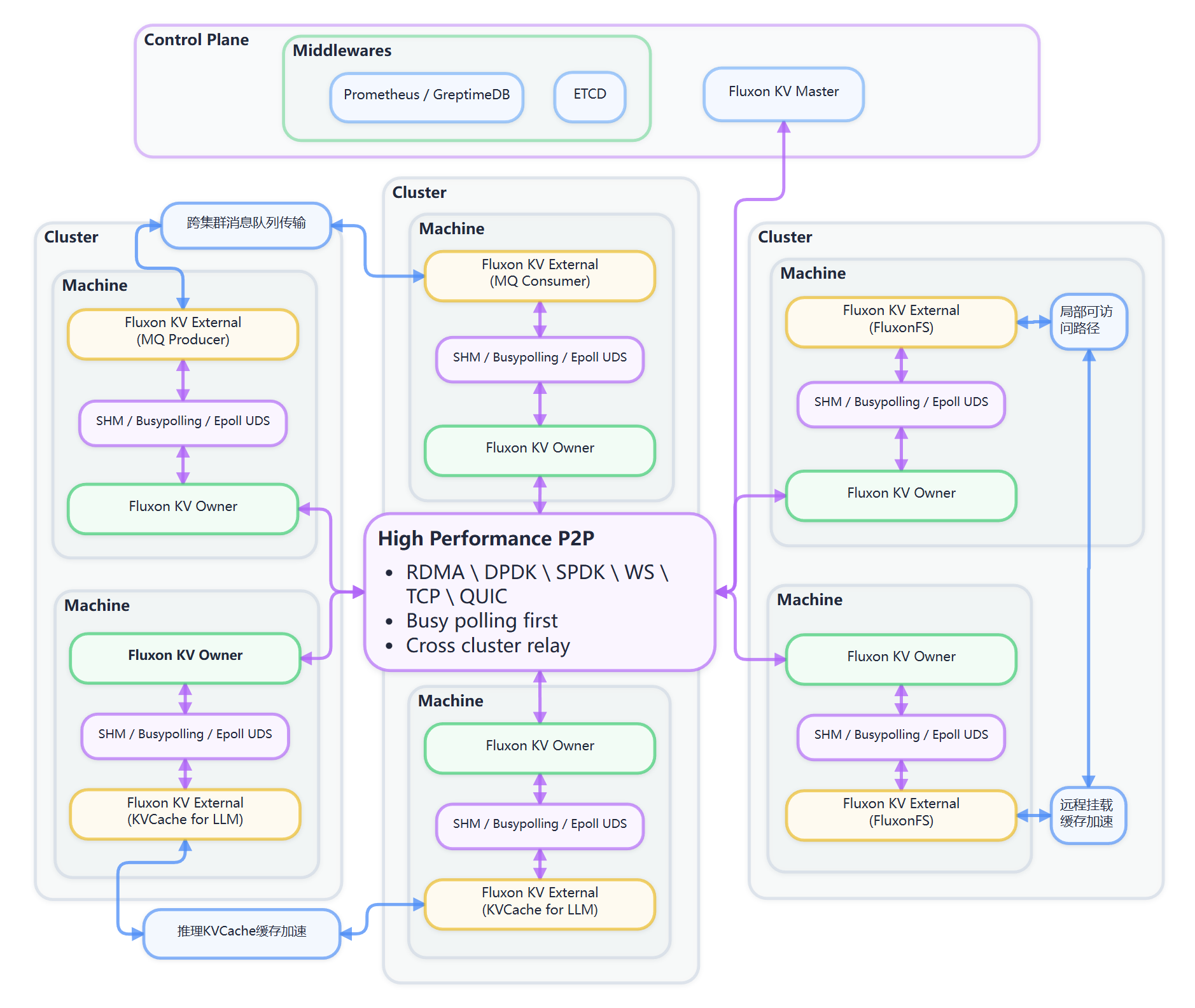
The most common objects are:
Greptime: standard observability pathetcd: KV control-plane metadatastart_kv_master_process(...): startsFluxon KV Masterstart_owner_kvclient_process(...): startsOwner Client
The minimal local startup example is examples/start_master_owner.py. It only starts Fluxon-native roles and assumes:
etcdat127.0.0.1:2379GreptimeHTTP at127.0.0.1:34030- the current Python environment already installed the unified
fluxon_py-*.whl
Minimal Role Startup Example
#!/usr/bin/env python3

import argparse

from pathlib import Path

from fluxon_py.runtime import (
    start_kv_master_process,
    start_owner_kvclient_process,
    wait_subproc_or_ctrlc,
)
from fluxon_py.runtime.process_runner import ManagedSubprocess

ETCD_ENDPOINT = "127.0.0.1:2379"
GREPTIME_HTTP_PORT = 34030
GREPTIME_BASE_URL = f"http://127.0.0.1:{GREPTIME_HTTP_PORT}"
CLUSTER_NAME = "demo-kv-cluster"
SHARE_MEM_PATH = Path("/dev/shm/fluxon_kv_demo").resolve()
WORKDIR = Path("/tmp/fluxon_kv_demo/runtime").resolve()
MASTER_PORT = 31000
MASTER_UI_PORT = 18080
MASTER_INSTANCE_KEY = "demo_kv_master"
OWNER_INSTANCE_KEY = "demo_kv_owner"
OWNER_DRAM_BYTES = 1073741824


def main() -> None:
    args = parse_args()
    log_dir = (WORKDIR / "log").resolve()

    if args.with_master:
        master_log_dir = (WORKDIR / "master_logs").resolve()
        master_log_dir.mkdir(parents=True, exist_ok=True)
        master_stdout_log = log_dir / "master.log"
        master_proc = start_kv_master_process(
            config=build_master_config(log_dir=master_log_dir),
            log_path=master_stdout_log,
        )
    else:
        master_stdout_log = None
        master_proc = None

    owner_stdout_log = log_dir / "owner.log"
    owner_proc = start_owner_kvclient_process(
        config=build_owner_config(),
        log_path=owner_stdout_log,
    )
    children = []
    if master_proc is not None:
        children.append(ManagedSubprocess(label="master", proc=master_proc))
    children.append(ManagedSubprocess(label="owner", proc=owner_proc))

    print(f"[fluxon_kv] share_mem_path: {SHARE_MEM_PATH}")
    print(f"[fluxon_kv] etcd endpoint: {ETCD_ENDPOINT}")
    print(f"[fluxon_kv] greptime base url: {GREPTIME_BASE_URL}")
    print(f"[fluxon_kv] start master in this script: {args.with_master}")
    if master_stdout_log is not None:
        print(f"[fluxon_kv] master stdout log: {master_stdout_log}")
        print(
            "[fluxon_kv] kv web ui: "
            f"http://<host-ip-or-domain>:{MASTER_UI_PORT}/view?cluster_name={CLUSTER_NAME}&member_kind=kv"
        )
    else:
        print("[fluxon_kv] master stdout log: disabled by --without-master")
    print(f"[fluxon_kv] owner stdout log: {owner_stdout_log}")
    stack_label = "master and owner" if args.with_master else "owner"
    print(f"[fluxon_kv] waiting for Ctrl-C to stop {stack_label}")
    wait_subproc_or_ctrlc(
        children,
        on_ctrlc=lambda: print(f"[fluxon_kv] caught Ctrl-C, stopping {stack_label}"),
    )


def parse_args() -> argparse.Namespace:
    parser = argparse.ArgumentParser(description="Start KV demo owner, optionally with a local master")
    group = parser.add_mutually_exclusive_group()
    group.add_argument("--with-master", dest="with_master", action="store_true")
    group.add_argument("--without-master", dest="with_master", action="store_false")
    parser.set_defaults(with_master=True)
    return parser.parse_args()


def build_master_config(*, log_dir: Path) -> dict:
    return {
        "instance_key": MASTER_INSTANCE_KEY,
        "cluster_name": CLUSTER_NAME,
        "port": MASTER_PORT,
        "etcd_endpoints": [ETCD_ENDPOINT],
        "log_dir": str(log_dir),
        "monitoring": {
            "prometheus_base_url": f"{GREPTIME_BASE_URL}/v1/prometheus",
            "prom_remote_write_url": [f"{GREPTIME_BASE_URL}/v1/prometheus/write"],
            "otlp_log_api": {
                "otlp_endpoint": f"{GREPTIME_BASE_URL}/v1/otlp/v1/logs",
            },
        },
        "master_ui": {
            "http_listen_addr": f"0.0.0.0:{MASTER_UI_PORT}",
        },
    }


def build_owner_config() -> dict:
    return {
        "instance_key": OWNER_INSTANCE_KEY,
        "contribute_to_cluster_pool_size": {
            "dram": OWNER_DRAM_BYTES,
            "vram": {},
        },
        "fluxonkv_spec": {
            "etcd_addresses": [ETCD_ENDPOINT],
            "cluster_name": CLUSTER_NAME,
            "share_mem_path": str(SHARE_MEM_PATH),
            "sub_cluster": "default",
            "large_file_paths": [str((WORKDIR / "large" / "owner").resolve())],
        },
    }


if __name__ == "__main__":
    main()
Start it with:
python3 examples/start_master_owner.py
python3 examples/start_master_owner.py --without-master
Lifecycle and Call Flow
FluxonKvClientConfig
            |
            v
new_store(cfg) -> KvClient
     |               |
     |               +-- KV: put_blocking / get_blocking / remove / is_exist / ...
     |               |
     |               +-- RPC server: rpc_register(path, handler)
     |               |
     |               +-- RPC client: rpc_call(node_id, path, payload, timeout_ms)
     |
     v
close()
Core Python Objects
FluxonKvClientConfig: config object, usually built from a Python dictnew_store(config: FluxonKvClientConfig) -> Result[KvClient, ApiError]: create one KV clientKvClient: single entrypoint for both KV and RPCKvClient.third_party_logs_dir() -> Result[str, ApiError]: return the Fluxon-assigned log root for third-party Python components. Components should derive their own subdirectories under this root, for examplemq/.MemHolder: successful result holder fromget_blocking(...)PutOptionalArgs: optional write controls, most commonlylease_id
Notes:
MemHolderdoes not exposebytes()directly; callaccess()and read the bytes field from the returned flat dictstore.close()waits until all user-visibleMemHolderreferences are droppedResultvalues must be consumed explicitly withunwrap()orunwrap_error()
Data Model
Both KV values and RPC payloads use one flat-dict contract:
FlatDict = Dict[str, Union[int, float, bool, str, bytes, dlpack]]
Minimal KV Example
examples/external_put_get_del.py:
#!/usr/bin/env python3

from fluxon_py import FluxonKvClientConfig, new_store

INSTANCE_KEY = "demo_kv_external"
CLUSTER_NAME = "demo-kv-cluster"
SHARE_MEM_PATH = "/dev/shm/fluxon_kv_demo"


def main() -> None:
    cfg = FluxonKvClientConfig(
        {
            "instance_key": INSTANCE_KEY,
            "fluxonkv_spec": {
                "cluster_name": CLUSTER_NAME,
                "share_mem_path": SHARE_MEM_PATH,
            },
        }
    )
    store = new_store(cfg).unwrap("new_store failed")

    key = "hello"
    value = b"world"

    try:
        store.put_blocking(key, {"payload": value}).unwrap("put_blocking failed")
        mem = store.get_blocking(key).unwrap("get_blocking failed")
        flat = mem.access().unwrap("mem.access failed")
        payload = flat["payload"]
        print(bytes(payload).decode("utf-8"))
        store.remove(key).unwrap("remove failed")
        exists = store.is_exist(key).unwrap("is_exist failed")
        if exists:
            raise RuntimeError("expected deleted key to be absent")
    finally:
        if "flat" in locals():
            del flat
        if "mem" in locals():
            del mem
        store.close().unwrap("close failed")


if __name__ == "__main__":
    main()
Useful calls:
put_blocking(key, value, opts=None): write or overwrite one KV objectget_blocking(key): returnMemHolderMemHolder.access(): expand toFlatDictget_size(key): query payload size without reading the whole objectis_exist(key): existence checkremove(key): delete a keythird_party_logs_dir(): return{large_file_paths[0]}/{cluster_name}_cluster_third_party_logsas aResult[str, ApiError]
To increase user-process logs:
FLUXON_LOG=DEBUG python3 examples/external_put_get_del.pyThird-party Python components should place file logs under store.third_party_logs_dir().unwrap(...) and then append a component subdirectory such as mq/. This keeps log directory usage bounded and lets the Fluxon observability plane discover and collect those file logs through one Owner Client-derived root.
Minimal Node-to-Node RPC Example
examples/rpc_call.py:
#!/usr/bin/env python3

import argparse
import signal

from fluxon_py import FluxonKvClientConfig, new_store

RPC_SERVER_INSTANCE_KEY = "demo_rpc_server"
RPC_CLIENT_INSTANCE_KEY = "demo_rpc_client"
CLUSTER_NAME = "demo-kv-cluster"
SHARE_MEM_PATH = "/dev/shm/fluxon_kv_demo"


def _build_config(*, instance_key: str) -> FluxonKvClientConfig:
    return FluxonKvClientConfig(
        {
            "instance_key": instance_key,
            "fluxonkv_spec": {
                "cluster_name": CLUSTER_NAME,
                "share_mem_path": SHARE_MEM_PATH,
            },
        }
    )


def run_server(*, instance_key: str) -> None:
    store = new_store(_build_config(instance_key=instance_key)).unwrap("new_store failed")
    count = 0

    def count_handler(from_node_id: str, payload: dict) -> dict:
        nonlocal count
        count += 1
        print(f"rpc from={from_node_id} payload={payload} count={count}")
        return {
            "count": count,
            "payload": payload["payload"],
        }

    try:
        store.rpc_register("/count", count_handler).unwrap("rpc_register failed")
        signal.pause()
    finally:
        store.close().unwrap("close failed")
Important constraints:
node_idusually matches the target node’sinstance_keytimeout_msdefaults to10000- Keep one primary public pattern:
rpc_call(...).wait()on the response handle
Config Objects
You usually touch two config layers:
Masterconfig: starts the control-plane process- external-client config: attaches business code to the local
Owner Clientand drives KV / RPC
Minimal master YAML:
instance_key: my-master-1
cluster_name: demo-kv-cluster
port: 31000
etcd_endpoints:
  - 127.0.0.1:2379
log_dir: /var/lib/fluxon/master_logs
Minimal external-client YAML:
instance_key: my-kv-client-1

fluxonkv_spec:
  cluster_name: demo-kv-cluster
  share_mem_path: /dev/shm/fluxon
  p2p_listen_port: 31001
Owner Client config adds memory contribution and etcd addresses:
instance_key: my-owner-1

contribute_to_cluster_pool_size:
  dram: 1677721600
  vram: {}

fluxonkv_spec:
  etcd_addresses:
    - 127.0.0.1:2379
  cluster_name: demo-kv-cluster
  share_mem_path: /dev/shm/fluxon
  p2p_listen_port: 31000
  sub_cluster: default
Keep these roots separate:
share_mem_path: shared bundle root. Runtime appendscluster_name, and that directory holdsmmap.file,shared.json, and peer metadata.large_file_paths:Owner Client-only large-file authority for logs, profiles, caches, and other derived runtime assetsFLUXON_LOG: console log threshold for the user process
In zero-contribution external mode, Owner Client-only fields such as fluxonkv_spec.etcd_addresses, fluxonkv_spec.sub_cluster, fluxonkv_spec.large_file_paths, and fluxonkv_spec.redis_compat should not appear.
Network and TCP thread reactor tuning
The stable network block contains network policy and transport tuning; it does not select the
protocol. rdma_device_names optionally pins the comma-separated RDMA devices used by the
process. tcp_reactor_mode controls how the current process’s tcpthr_reactor_* threads wait
for work. When omitted, zero-contribution external clients default to event_driven, while owners
and masters default to busy_poll. Every role can explicitly select either mode:
network:
  rdma_device_names: mlx5_0
  tcp_reactor_mode: event_driven
Production protocol selection is not configurable. When no test override is present, the public bundled Fluxon KV runtime keeps its current default, RDMA. Tests and benchmarks that need protocol selection or fault-isolation switches should use the separate Developer - 9 - Test Extension Configuration.
| Value | Behavior and tradeoff |
|---|---|
busy_poll (owner/master default) | Uses zero-timeout polling during the hot window. This reduces wake-up and scheduling latency but consumes more CPU. |
event_driven (external default) | Blocks in mio::Poll for socket readiness and uses mio::Waker for new commands and send work. This lowers idle CPU usage but may add a small amount of wake-up and scheduling latency. |
This is a process-level setting. All tcp_thread P2P connections in one process share the same
wait mode, so FS RPC and KV RPC cannot select different modes inside that process. The setting
controls only the local TCP reactor; the communication peer’s wait mode is unaffected.
Connection control and other async work continue to run on the Tokio runtime. After the handshake,
the primary TCP data path continues to run on dedicated tcpthr_reactor_* OS threads.