Service Plane
To use Fluxon KV you need to understand the fixed service-plane objects that come before your business process. They own control-plane metadata, the shared memory pool, and the startup choreography for KV roles.
From a user point of view the most common objects are:
- External dependencies:
etcd,Greptime,TiKV - Fluxon-native roles:
Master,Owner Client - Startup entrypoints: raw
etcd / Greptime / TiKVruntimes,fluxon_py.runtime, and your own supervisor or scripts
If you are writing business code, this page answers three questions:
- Which processes must be started first
- How those processes relate to one another
- Which objects may be started by
fluxon_py.runtimeand which may not
For the user-facing API, continue to User - 3 - KV and RPC Interface.
Role Model
The service plane can be reduced to five stable objects:
- External dependency:
etcd - External dependency:
Greptime - External dependency:
TiKV - Fluxon-native role:
Master - Fluxon-native role:
Owner Client
Deployment layout:
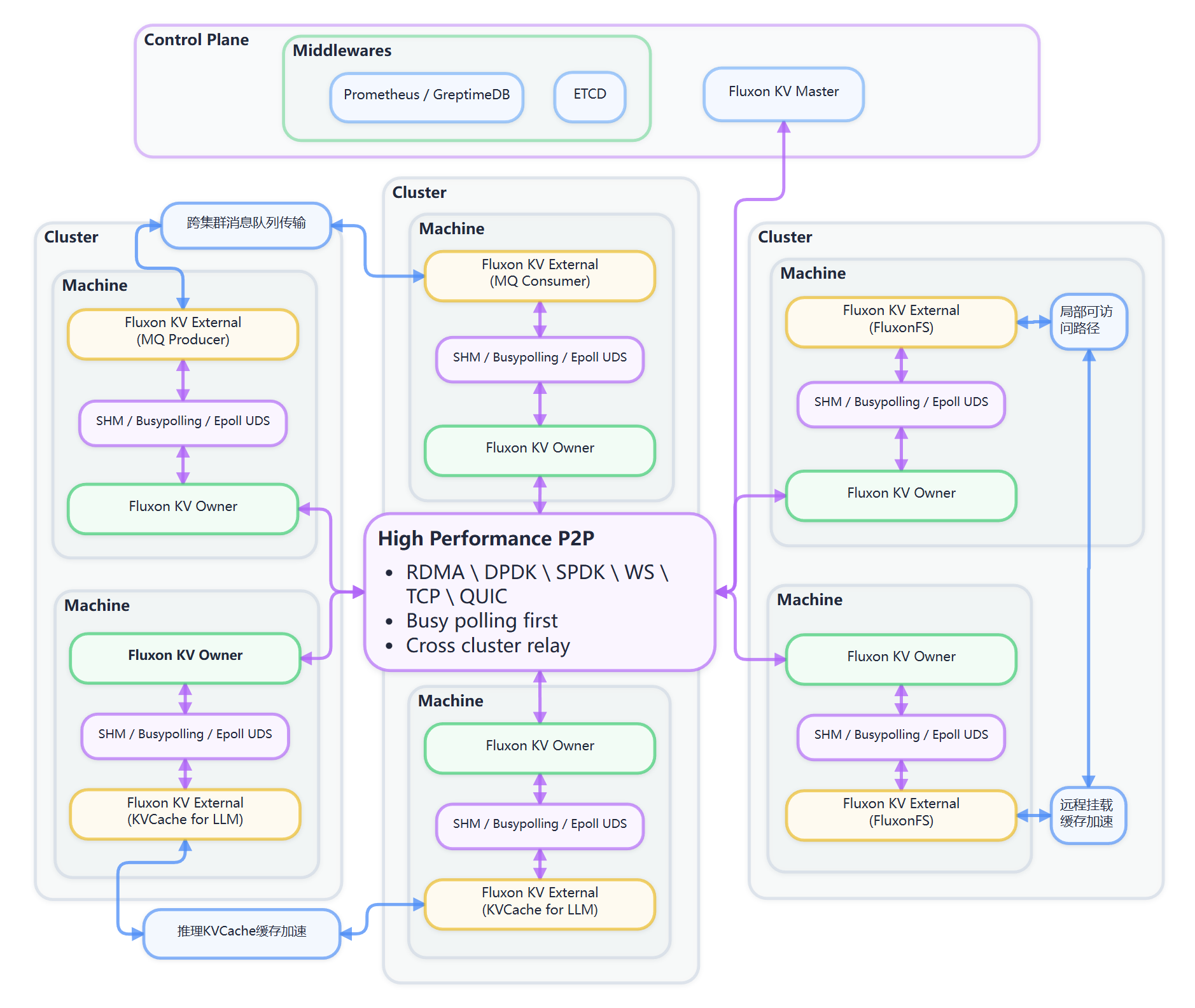
Responsibilities:
etcd: control-plane metadataGreptime: standard observability pathTiKV: persistent task-state storage for extended features such as FS transfer-state persistenceMaster: membership, routing, leases, monitoring broadcast, master-side logsOwner Client: local shared-memory pool andshared.json
Minimum Startup Order
The minimum chain for KV is:
- KV:
Greptime -> etcd -> Fluxon KV Master -> Owner Client -> business process new_store(...)
If you also need transfer-state-backed features such as directory transfer or pre-scan, add:
- Transfer / Pre-Scan:
TiKV PD -> TiKV -> FS Master transfer_state_store
Hard boundary:
etcd,Greptime, andTiKVare external dependenciesMasterandOwner Clientare Fluxon-native roles
If the control plane is missing, Master is unavailable. If Owner Client is missing, FluxonKvClientConfig({...}) -> new_store(...) cannot attach to the shared-memory pool. TiKV is not needed for the minimum KV read/write path, but it is required for features that depend on transfer_state_store.
Start etcd, Greptime, and TiKV
First prepare the runtime package described in User - 0 - Installation and confirm these files exist:
ext_images/etcd/etcdext_images/etcd/etcdctlext_images/etcd/start.shext_images/greptime/greptimeext_images/greptime/start.shext_images/tikv/pd-serverext_images/tikv/tikv-serverext_images/tikv/start_pd.shext_images/tikv/start_tikv.sh
All startup scripts use the same contract:
--config/-c: shell config file--workdir/-w: local work directory
Example etcd config:
cat > /tmp/etcd.config.sh <<'EOF'
ETCD_ARGS=(
  --data-dir "$WORKDIR/etcd-data"
  --name etcd0
  --advertise-client-urls "http://127.0.0.1:2379"
  --listen-client-urls "http://0.0.0.0:2379"
  --listen-peer-urls "http://0.0.0.0:2380"
  --initial-advertise-peer-urls "http://127.0.0.1:2380"
  --initial-cluster "etcd0=http://127.0.0.1:2380"
  --initial-cluster-token "etcd-cluster"
  --initial-cluster-state "new"
  --auto-compaction-retention=1
)
EOF

bash ./ext_images/etcd/start.sh \
  --config /tmp/etcd.config.sh \
  --workdir /tmp/fluxon_service_plane_demo/etcd
Example greptime config:
cat > /tmp/greptime.config.sh <<'EOF'
GREPTIME_ARGS=(
  standalone start
  --data-home "$WORKDIR/greptimedb"
  --http-addr 0.0.0.0:34030
)
EOF

bash ./ext_images/greptime/start.sh \
  --config /tmp/greptime.config.sh \
  --workdir /tmp/fluxon_service_plane_demo/greptime
Example TiKV PD config:
cat > /tmp/pd.config.sh <<'EOF'
PD_ARGS=(
  --name pd0
  --data-dir "$WORKDIR/pd-data"
  --client-urls "http://127.0.0.1:12379"
  --advertise-client-urls "http://127.0.0.1:12379"
  --peer-urls "http://127.0.0.1:12380"
  --advertise-peer-urls "http://127.0.0.1:12380"
  --initial-cluster "pd0=http://127.0.0.1:12380"
  --log-file "$WORKDIR/pd.log"
)
EOF

bash ./ext_images/tikv/start_pd.sh \
  --config /tmp/pd.config.sh \
  --workdir /tmp/fluxon_service_plane_demo/tikv_pd
Example TiKV config:
cat > /tmp/tikv.config.sh <<'EOF'
TIKV_ARGS=(
  --pd-endpoints "127.0.0.1:12379"
  --addr "127.0.0.1:20160"
  --advertise-addr "127.0.0.1:20160"
  --status-addr "127.0.0.1:20180"
  --data-dir "$WORKDIR/tikv-data"
  --log-file "$WORKDIR/tikv.log"
)
EOF

bash ./ext_images/tikv/start_tikv.sh \
  --config /tmp/tikv.config.sh \
  --workdir /tmp/fluxon_service_plane_demo/tikv
These external services are not started by fluxon_py.runtime.
fluxon_py.runtime
fluxon_py.runtime only manages Fluxon-native roles. It does not replace etcd, Greptime, or TiKV.
Common entrypoints:
start_kv_master_process(config=...)start_owner_kvclient_process(config=...)
Optional wrapper log argument:
log_path=...
This controls the Python wrapper subprocess stdout/stderr destination, not the service’s own business-log directory.
If you are an installed-wheel user, prefer these Python entrypoints directly and pass Python dicts instead of depending on examples/ path layout.
See examples/start_master_owner.py for the common local pattern:
- Default: start
Master + Owner Client --without-master: start onlyOwner Clientand attach to an existingMaster
The same role chain is reused by MQ and FS. MQ-specific behavior belongs to User - 4 - MQ Interface and FS-specific behavior belongs to User - 5 - FS Interface.